How to onboard affiliates so they actually make a first sale
Affiliate onboarding done right: the first-week sequence, the assets partners need, and how to get every new affiliate to their first sale — a practical guide for SaaS founders.
By The RewardSpring Team · August 12, 2026 · 5 min read
You did the hard part. You built the program, you sent the outreach, and a handful of partners actually said yes. Then nothing. The dashboard shows signups but zero clicks, and the affiliates who were so enthusiastic on the call have gone quiet. This is the most common failure point in any partner program, and it is almost never a motivation problem — it is an onboarding problem. If you have not filled your roster yet, start with how to recruit affiliates for your SaaS. This guide picks up the moment after someone signs and walks through the affiliate onboarding sequence that turns a fresh signup into a partner who actually sends you customers.
The first 48 hours decide everything
A new affiliate is never more motivated than the moment they sign up. They just said yes to promoting you, the intent is fresh, and their calendar is clear. Every hour you wait, that intent decays. The partner who was ready to tweet about you on Monday has forgotten by Friday, buried under their own work. So the single highest-leverage thing you can do is make the first two days effortless: a warm welcome, their link ready to copy, and one obvious action to take today. Treat onboarding like a product launch for an audience of one.
Send a welcome that does one job
Your welcome email should not be a wall of policy and links. It has exactly one job: get the partner to grab their link and share it once. Everything that does not serve that goal is noise. Keep it short, human, and action-first:
- Their unique referral link, above the fold and ready to copy — no hunting through a dashboard.
- One suggested first action — a single tweet, a DM to a relevant contact, or adding the link to a resource they already maintain.
- A small library of ready-to-use assets so they never have to start from a blank page.
- A real name and a reply-to that reaches a human, so questions get answered before momentum dies.
Give them assets, not a blank page
Most affiliates stall for an embarrassingly simple reason: they do not know what to say. Writing about someone else's product from scratch is real work, and unpaid partners will quietly skip it. Remove the excuse. Hand them copy they can paste and lightly tweak — two or three sample social posts, a short email blurb, a one-line description of what you do, and a few approved images. Spell out your value proposition on your features page and mirror that language in the assets, so every partner's message sounds like a sharper version of your own.
Set one clear first goal
Ambiguity kills momentum. “Go promote us” is not a goal; “share your link with one relevant person or channel this week” is. Give every new partner a single achievable milestone and mark it when it happens. The first click, then the first signup, then the first paid conversion — each is a small win that builds the habit. A partner who lands one sale in week one is far more likely to stay active than one who is still waiting to figure out where to begin.
Make the reward obvious early
Partners lose interest when the payoff feels abstract. During onboarding, show them exactly what they earn and when. If your commissions are recurring, make that unmistakable — someone who understands that one referral pays every month for a year behaves very differently from someone who thinks it is a one-time bounty. We break down why in the math of recurring commissions. Be just as clear about payouts: when partners get paid, how, and what they need to provide. Our guide on how to pay affiliates covers the mechanics so nobody is left guessing.
Check in before they go cold
Onboarding is a short sequence, not a single email. A light three-touch cadence over the first two weeks keeps new partners warm without nagging them: a welcome on day zero, a nudge with a fresh asset on day three, and a genuine check-in around day ten that asks whether anything is blocking them. That last message matters most — the answer is usually a small, fixable friction, and fixing it is the difference between a dormant signup and an active affiliate.
A simple first-week onboarding checklist
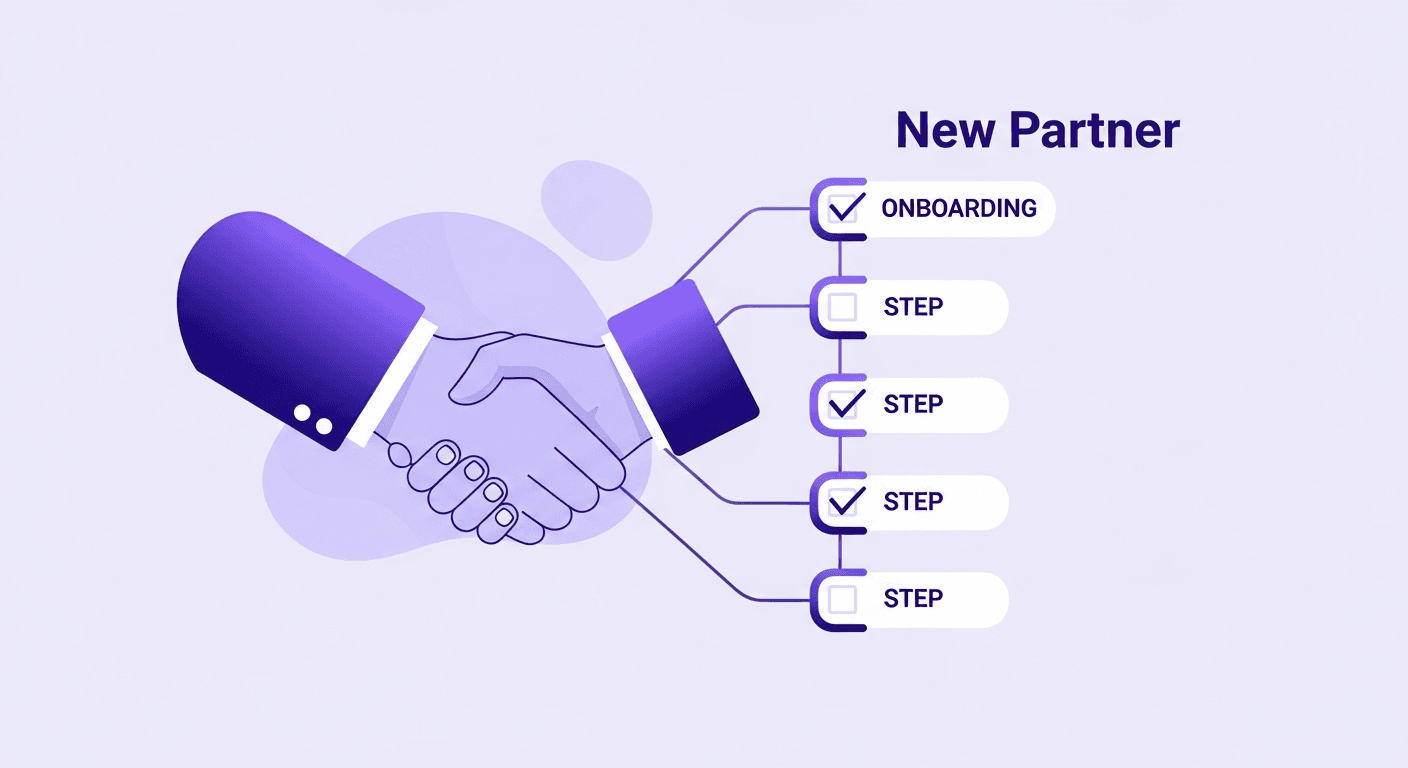
- Day 0 — approve the partner and send the welcome with their link and one suggested first action.
- Day 1 — confirm their link works and they can see their own dashboard and stats.
- Day 3 — share a ready-to-use asset plus one content idea tailored to their audience.
- Day 7 — review their first clicks together and remove any friction you spot.
- Day 14 — celebrate the first conversion, or diagnose honestly why it has not happened yet.
Let the tooling carry the routine
You cannot hand-hold every partner forever, and you should not have to. The point of good onboarding is to make the repeatable parts automatic — the welcome, the link, the asset library, the payout clarity — so your attention goes to the relationships that genuinely need it. RewardSpring is built to do exactly that: partners self-serve their links and watch their earnings update in real time on a Stripe-native dashboard, so onboarding becomes a link and a login rather than a spreadsheet and a prayer.
Great affiliate onboarding is not complicated, but it is deliberate: move fast in the first 48 hours, remove every excuse not to share, and make both the next step and the reward impossible to miss. Do that, and your quiet signups become partners who actually sell. Ready to give your affiliates an onboarding experience that runs itself? Start free with RewardSpring and have your first partner live in minutes.
Run this on your own SaaS
Connect Stripe and launch partner and customer referral programs in minutes.
Start your free trial